|
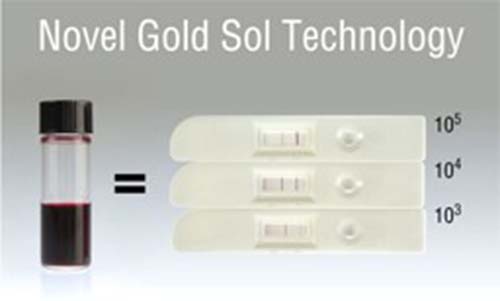
Lateral-flow chromatographic and flow-through tests offer fast detection of critical components for use in point-of-care testing. The key to flow-through tests is the ability to covalently attach antibodies to intensely colored, nanometer particles.
Gold sols that bind ligands through a sulfur bond have proved highly successful for this application. For optimal binding of the antibody or protein while retaining a high degree of specific activity, the pH of the gold sol must be adjusted to slightly above the iso-electric point of the coating antibody or protein.
This is done through a series of pH titrations with the provided buffers. Varying amounts of buffers A and B, and varying amounts of buffers C and D are added to the gold to create a pH 5-11 range. Next, antibody or protein is added, and after 30 minutes the reaction is stopped.

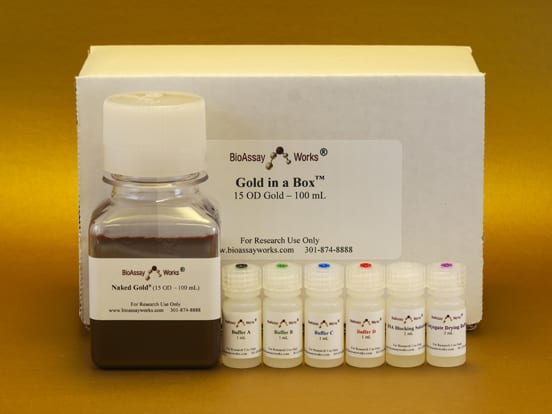
Kit Components for NGIB01-B018 (components for B044 and B100 s are proportionally larger)
- Naked Gold Sol 40 nm - 9.0 ml (cap with black ring)
- Naked Gold Sol 20 nm - 9.0 ml (cap with red ring)
- Buffer Solution A - 1.0 ml (cap with black dot)
- Buffer Solution B - 1.0 ml (cap with green dot)
- Buffer Solution C - 1.0 ml (cap with blue dot)
- Buffer Solution D - 1.0 ml (cap with red dot)
- BSA Blocking Stabilizer Solution - 2.0 ml (clear cap)
- Gold Drying Buffer - 2 ml (cap with purple dot)
Materials required but not provided: Clean glass or polystyrene test tubes (12 x 75 mm); pipettes and tips
INSTRUCTIONS
Sample Preparation: The antibodies or proteins used with this kit must be at a concentration of 1 mg/ml or greater and should be in a 0.5 X PBS buffer solution. If they are not in a 0.5 X PBS buffer solution, then dialyze the antibody or protein against 0.5 X PBS. Proteins at a concentration of 2 mg/ml or greater should be in 1 X PBS.
Generic Procedure, Gold in a Box: Note: Use aseptic technique when handling the gold sol.
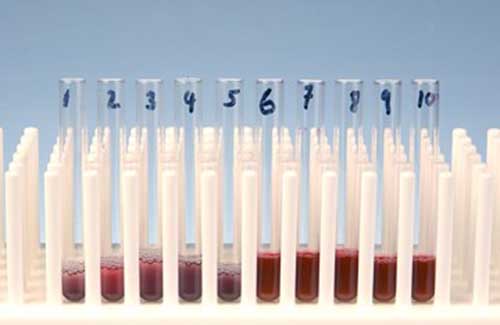
1. Shake or swirl gold to resuspend any settled gold. Place 0.5 ml Naked Gold sol into ten (10) clean individual test tubes. 2. Label each tube with the pH value (or, 1 through 10) from the provided pH charts. 3. Use the pH charts to add varying amounts of buffer in microliters to each test tube. Shake to mix. 4. Place each tube on a low speed vortexer and add antibody solution (See Sample Preparation Section). Mix thoroughly (about 2 to 3 seconds).
Ideally, for the 40 nm gold, 7 ul of a 2 mg/ml solution of antibody or protein is optimal. For the 20 nm gold, ideally, 14 ul of a 2 mg/ml solution of antibody or protein is optimal.
Note: The saturation point for 40 nm gold is typically near 30 mcg of antibody per ml of gold. The saturation point for 20 nm gold is about 60 to 70 mcg of antibody per ml of gold.
5. A deepening purple color and/or black precipitate on some tubes indicates that the antibody or protein is below its iso-electric point, leading to cross-linking of individual gold sols. Cross-linked sols cannot be used in immunological assays and should be discarded. Deep purple sols are usually mostly inactive as well. Only tubes with a slight purple color or no change in color are useful for immunological assays. 6. Allow the reaction to continue for a total of 30 minutes.
Note: See section below on “Stability of Gold Conjugatesâ€.
7. Stop the reaction by the addition of 50 ul of Blocking Stabilizer Solution.
Note: In some conjugates that result in non-specific reactivity, it is often best to allow the blocker to react for an additional 16 hours at room temperature.
Stability of Gold Conjugates, Gold in a Box:
Gold particles completely coated with protein take on the properties of the coating proteins and become very stable in solutions of high ionic strength. An excellent way to test the effectiveness of the conjugation reaction is to combine 10 ul of coated gold sol (prior to the addition of the BSA blocking solution) with 10 ul of 1 M NaCl. Sols with incomplete coating will fall out of solution (turn black), while completely coated sols will remain stable (red).
Testing of BSA Blocked Gold Conjugates:
Conjugate is now ready for use in a rapid assay at nominal usage of 5-15 ul per assay. Tubes that have a slight color change and ones with no color change should be assayed for optimal activity. Tubes with the best activity are usually a good indicator of the approximate iso-electric point of the coated antibody or protein.
In order to effectively dry down the gold, add 0.1 ml of Gold Drying Buffer for every 1.0 ml of conjugate. Mix thoroughly. Apply gradually and evenly to either glass fiber or polyester ribbon.
Place polyester ribbon in a vented 37 C oven or incubator for four (4) hours to dry thoroughly. Glass fiber ribbon should be left in the incubator overnight.
The following alternative drying procedure is for polyester ribbon only: If a vented incubator is not available, use a hairdryer set to deliver 30 C heat at a ten (10) inch distance from the ribbon surface. Usually, three (3) or four (4) minutes in a wave-motion will suffice to thoroughly dry the ribbon.
Store all dried ribbons in a glass tightly sealable container containing ample desiccants (granular or pouch-form).
Note: This generic procedure may be modified or scaled as needed. When developing a new assay, it is important to determine the optimal amount of ligand to add to the gold particles. Once the tubes have been assayed, it is useful to further optimize binding by both decreasing or increasing the amount of antibody added to each tube. Often, a 20% increase or decrease in antibody or protein added is sufficient to yield an optimal coating procedure. A few cases require a 40% or more increase or decrease in coating antibody or protein.
Discussion, Gold in a Box: A sensitive lateral flow assay requires that all of the antibody or protein that is added to the gold sol be irreversibly bound to the beads. Any free antibody or protein serves to short-circuit the assay. This behavior ultimately sets the sensitivity limits of an assay. Nano-gold particles remain in solution because they repel each other due to a significant negative charge. This means that proteins bind to gold particles through both ion-exchange attraction and covalent bonding of protein thiols (-SH) with surface gold. The challenge for preparing stable gold conjugates in this Gold-in-a-Box format depends upon one's ability to manage the binding of antibody or proteins at or near their iso-electric point. In a few cases, the titration of the pH may need to be fine tuned. The antibodies or proteins in the sample must display a suitable number of surface thiols (-SH). Proteins with no surface thiol groups bind exchangeably with gold particles through ion-exchange interactions. Such proteins do not form stable gold sols that are suitable for flowing chromatographic assays. Equally problematic are protein preparations where surface thiols have been capped or protected by reaction with N-ethyl maleimide or iodoacetic acid.
Application of Gold conjugates, Gold in a Box: Stabilized gold conjugates made from concentrated sols are ready for use in lateral-flow and flow-through assays without additional optimizations. Typically, 5-15 ul gold conjugate per test will give optimally sensitive assays. The gold conjugate is excellent for use in a variety of gold amplified assay procedures. This includes BioAssay Works' patented, ultra-sensitive C-FLAT technology. Researchers interested in evaluating this technology may contact BioAssay Works for a research use license with no fee.
pH Chart for Optimal coating at a pH of 5-11 (per 0.5 ml of gold)
| Tube # |
pH |
Buffer A |
Buffer B |
| 1 |
5.4 |
9 ul |
1 ul |
| 2 |
6.6 |
8 ul |
2 ul |
| 3 |
7.3 |
6 ul |
4 ul |
| 4 |
7.8 |
4 ul |
6 ul |
| 5 |
8.2 |
2 ul |
8 ul |
| Tube # |
pH |
Buffer A |
Buffer B |
| 6 |
8.4 |
10 ul |
0 ul |
| 7 |
8.8 |
8 ul |
2 ul |
| 8 |
9.2 |
6 ul |
4 ul |
| 9 |
9.6 |
4 ul |
6 ul |
| 10 |
10.1 |
2 ul |
8 ul |
Note: All buffers and the BSA stabilizer contain less than 0.1 % of sodium azide. Sodium azide is very toxic if ingested or inhaled. Avoid contact with skin, eyes, or clothing. Wear eye or face protection when h andling. If skin or eye contact occurs, wash with copious amounts of water. If ingested or inhaled, contact a physician immediatley. Sodium azide yields toxic hydrazoic acid under acidic conditions. Dilute azide-containing compounds in running water before discarding to avoid accumulation of potential explosive deposits in lead or copper plumbing. |